LandlordOS
 HOAOS
 PropPay
 PraxiOS
 Engage
 Books
 Field Service
 HCM
 ATS
 FormRelay
 AppOS
Board elections are where a volunteer association is most likely to end up in an argument, and almost always over process: who was allowed to run, whether notice went out on time, whether there was a quorum, who counted. None of that is hard to get right, but it has to be planned before the first ballot goes out. Here is the sequence that works for a small, self-managed community.
Which rules control an HOA election?
Start with three sources, and read them before you set a date:
- State law. Many states set minimum notice periods, say how ballots must be handled and limit or regulate proxies. Where the statute and your documents disagree, the statute usually wins.
- The bylaws. These normally set the number of seats, term lengths, who is eligible to run and vote, how nominations work, the quorum and how votes are counted.
- Election rules the board has adopted, if any. Some associations have a separate written procedure covering inspectors, ballot handling and deadlines.
Write down the answers to a short list of questions: how many seats are open and for what terms, who may vote (usually one vote per unit or lot), whether owners behind on dues can vote or run, what the quorum is, whether proxies or absentee ballots are allowed, whether the ballot must be secret, and whether cumulative voting applies. If you can’t answer one of them from the documents, find out now, not on election night.
What does an election timeline look like?
Pick the meeting date first, then count backward. The exact number of days comes from your documents and state law, but the order is nearly always the same.
Put real dates on each stage and publish the whole schedule with the first announcement. Owners who can see the deadlines in advance have far less to complain about later.
How do you handle nominations?
Announce the open seats and invite candidates well before ballots are printed. Say exactly how to put a name forward, the deadline and what a candidate must provide. A short written statement from each candidate, with the same word limit for everyone, helps owners choose and keeps the board out of the business of describing candidates.
Check each candidate against the eligibility rules in your bylaws and nothing else. The current board should not screen candidates for any reason the documents don’t give. If your documents allow nominations from the floor at the meeting, plan for it, because it affects how the ballot is printed and when voting can close.
What goes in the meeting notice and ballot?
The notice should state the date, time and place of the meeting, that an election will be held, the seats open, and how to vote if an owner can’t attend. Send it the way your documents require and keep proof of when and how it went out. Our HOA annual meeting checklist covers the rest of the meeting preparation.
On the ballot, list candidates in a neutral order, such as alphabetical or drawn by lot, and state how many may be chosen. If your community votes by secret ballot, use a method that separates the voter’s identity from the choices: commonly an unmarked inner envelope holding the ballot, inside an outer envelope that the owner signs and that identifies the unit. The outer envelope is checked against the owner list; the inner one is opened only at the count.
How do you reach quorum?
Failing to reach quorum is the most common reason small associations can’t hold a valid election. The fix is to make voting easy and start early:
- Offer every method your documents and state law allow: in person, by mail, by proxy and online.
- Send reminders as the deadline approaches, and tell owners how far the community is from quorum.
- Ask board members and volunteers to knock on doors for ballots or proxies, without telling anyone how to vote.
- Know in advance what your documents say happens if quorum isn’t met, such as adjourning to a later date.
Track which units have voted, by which method, so that no unit is counted twice and you always know the turnout.
Who counts the votes, and how?
Candidates and their households should not handle or count ballots. Appoint one or more inspectors of election: owners who aren’t running, or an outside party such as the association’s accountant or attorney. Some states require independent inspectors, so check.
Count in the open, at the meeting, where any owner can watch. Confirm quorum first. Then tally the votes, have two people check the totals, and announce the result. Decide before the count how a tie is resolved; your bylaws may say, and if they don’t, a runoff between the tied candidates is the usual answer.
What should the board do after the election?
- Record the result in the minutes: the number of units voting, that quorum was met, the votes for each candidate and who was elected to which term.
- Keep the ballots, envelopes, proxies and sign-in sheets for as long as your state requires, in case the result is challenged.
- Tell every owner the result promptly, not only those who attended.
- Hand over: bank signers, software logins, the document archive and the list of open issues. The new board usually elects its officers at its first meeting.
How HOAOS handles board elections
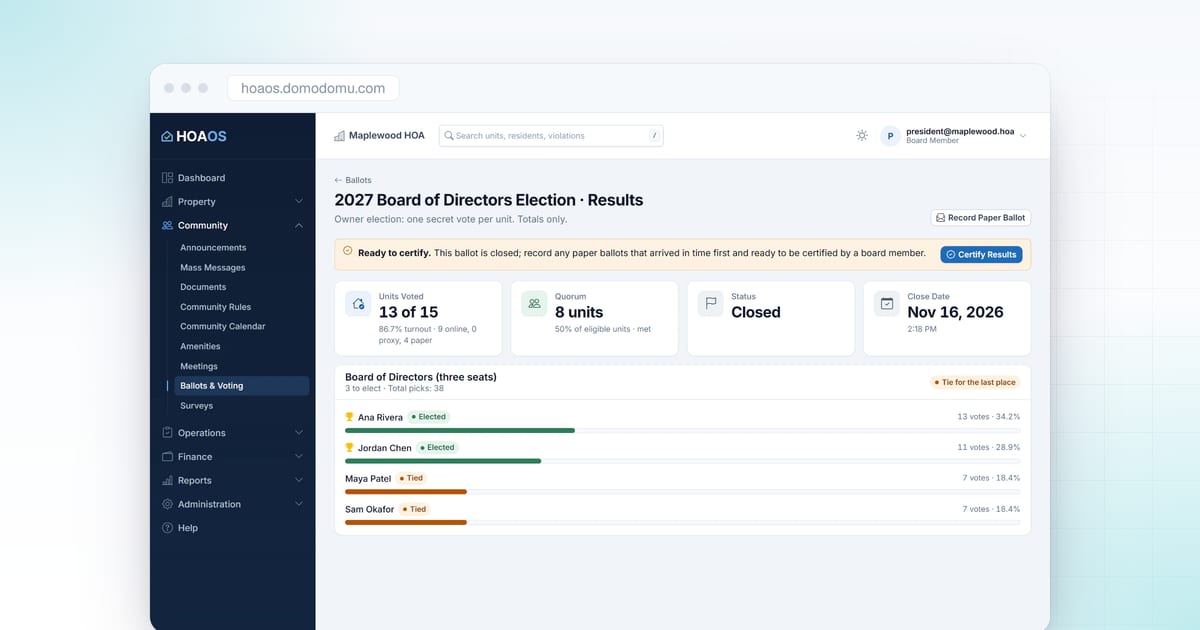
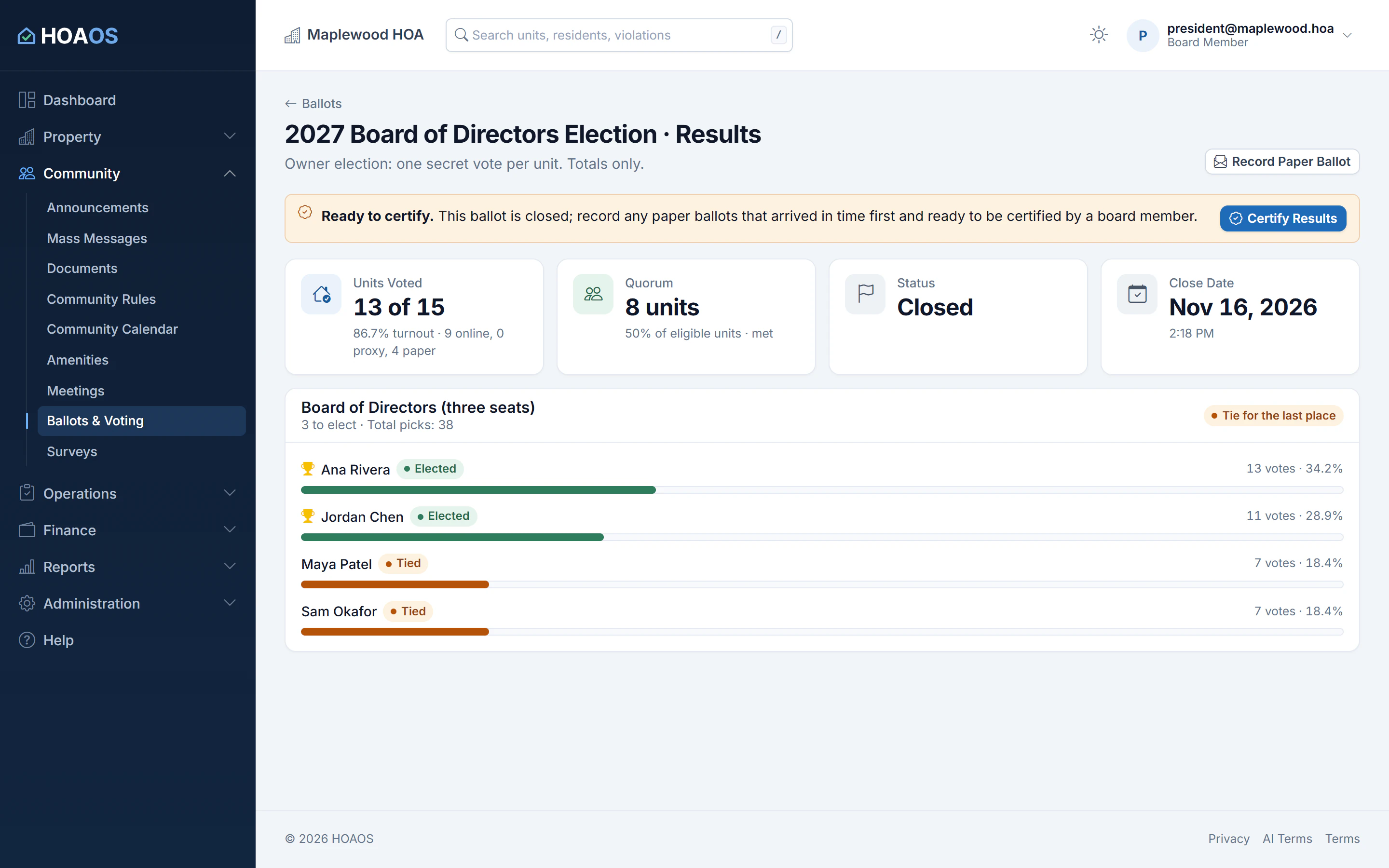
HOAOS includes owner elections on every plan. The board creates the election, sets when it opens and closes, enters the quorum as a percentage of units and lists the candidates with a statement under each name, including "vote for up to N" for multi-seat elections. Each unit gets one vote, cast by a current owner online, through a general or directed proxy, or on a paper ballot the board records.
The election is secret: HOAOS stores the fact that a unit voted separately from what was chosen, so nobody, including the board, can see how a unit voted. The board sees turnout by method against the quorum while voting is open, residents see the results once it closes, ties are flagged, and the board certifies the result and prints a certificate.
Three limits to know about. Every unit has one equal vote, so HOAOS doesn’t do weighted (percentage-interest) voting. Opening an election doesn’t email owners by itself; the board sends the notice as an announcement or mass message. And HOAOS doesn’t read the quorum or the rules from your bylaws: the board enters them, so the steps above still apply. See HOAOS meetings and voting for the details.