 HOAOS
 LandlordOS
 PraxiOS
HOAOS Violations
HOA violation tracking
software
HOAOS is HOA violation tracking software that takes a violation from the first photo to a closed case. The board logs it, sends first and second notices with a cure-by date, holds a hearing if needed and imposes a fine that posts to the unit's ledger. Every letter is stored exactly as sent, and owners can see the cases on their own unit.
- Included on every plan
- Every letter stored as sent
- Fines post to the unit ledger
Example HOAOS violations list: a lawn-height case at first notice, a parked trailer at second notice, a fence colour with a hearing scheduled, trash bins with a monthly fine, and holiday lights resolved.
Key facts
- Who it's for
- HOA and condo association boards and their property managersOwners see cases on their own units
- Steps
- Open → first notice → second notice → hearing → fine, closed as Resolved or Dismissed
- Evidence
- Multiple photos per violation, a timestamped enforcement history and every letter stored as sent
- Delivery
- Letters are emailed to the unit's current residents; print them, or have HOAOS mail them first class or certified
- Fines
- One-time, weekly or monthlyPosted to the unit's ledger as charges
- Plans
- From $50/moIncluded on every plan, from $50/mo for up to 50 units
01 / Logging
How do you log an HOA violation in HOAOS?
A board member picks the unit, the date, the violation type and describes what was observed and where, then attaches as many photos as needed. More photos can be added later. The case starts as Open: recorded, with no notice sent yet.
Violation types are your community's own catalog, such as “Trash cans visible” or “Unapproved exterior change”. Each one can carry its own cure period, the fine the board usually imposes and a link to the community rule it enforces, which is then quoted in the notice letter.
- A default cure period for the community (14 days unless you change it), overridden per type
- Open-only filter, bulk resolve or dismiss, and CSV export of the list
- A yearly violations summary report
02 / Notice letters
What do violation notices look like?
They are formal letters, built by HOAOS from the violation and your letterhead. Each one has the association's name and return address, the owner's name, what was observed, the rule it breaks, the date to correct it by, an optional message from the board and the board's signature. HOAOS writes four kinds: first notice, second notice, hearing notice and fine notice.
When a board member sends a notice, HOAOS stores the letter exactly as it went out, so the record never changes if your settings do. It emails the letter to every current resident of the unit, whatever their notification settings, because a notice is a formal step.
For owners who need paper, print the letter, or have HOAOS mail it through its print-and-mail service, first class or certified, with tracking. The price is shown before you send and billed on your HOAOS invoice.
Example second notice letter from Maple Ridge Homeowners Association about a trailer parked on the street, quoting the community rule and asking for it to be corrected by October 30.
03 / Escalation
How does a violation escalate to a hearing and a fine?
Step by step, each one a deliberate action by the board, never a silent status change. HOAOS keeps the history of every step with its date and who took it.
- STEP 01
First notice
Sets the cure-by date from the type's cure period or the community default.
- STEP 02
Second notice
If it isn't corrected, a second letter refers back to the first and sets a new date.
- STEP 03
Hearing
Held at a board meeting, where it joins the agenda, or at its own time and place. HOAOS warns you if it's sooner than your notice period (10 days by default).
- STEP 04
Fine
One-time, weekly or monthly. It posts to the unit's ledger, and recurring fines post again each period until stopped or the case closes.
- STEP 05
Close
Resolved when it's corrected, or dismissed. A closed case can be reopened.
04 / Homeowner view
What can homeowners see about a violation?
Owners and tenants who sign in see the violations on their own units, and only those: the description, the photos, the enforcement history, every letter sent and the board's notes on the case. Board notes are visible to the unit's residents, and HOAOS says so on the form.
An owner who disagrees with a fine can dispute the charge from the resident portal with an explanation. The board reviews it, approves or denies it, and on approval HOAOS posts a credit to the unit's ledger.
Who sees what
- Board and managers
- Every violation in the communityLog, send notices, schedule hearings, fine, resolve, dismiss
- Owners and tenants
- Violations on their own units onlyWith photos, letters, history and notes; read-only
- Disputes
- Owners can dispute a fine chargeAn approved dispute becomes a credit
- Other units
- Never visible to residents
Inside HOAOS
See it in the app.
Real HOAOS screens, with demo data loaded.
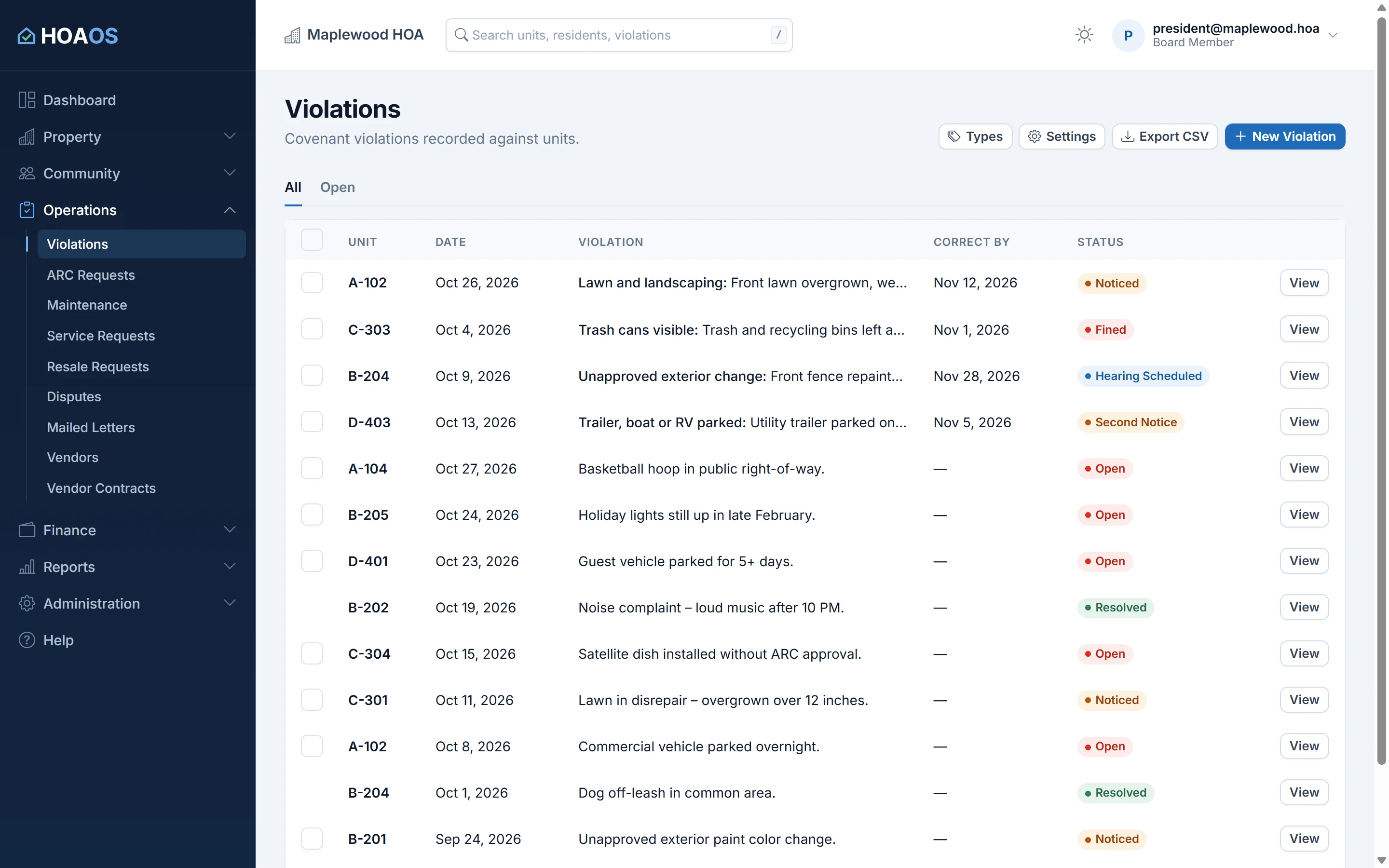
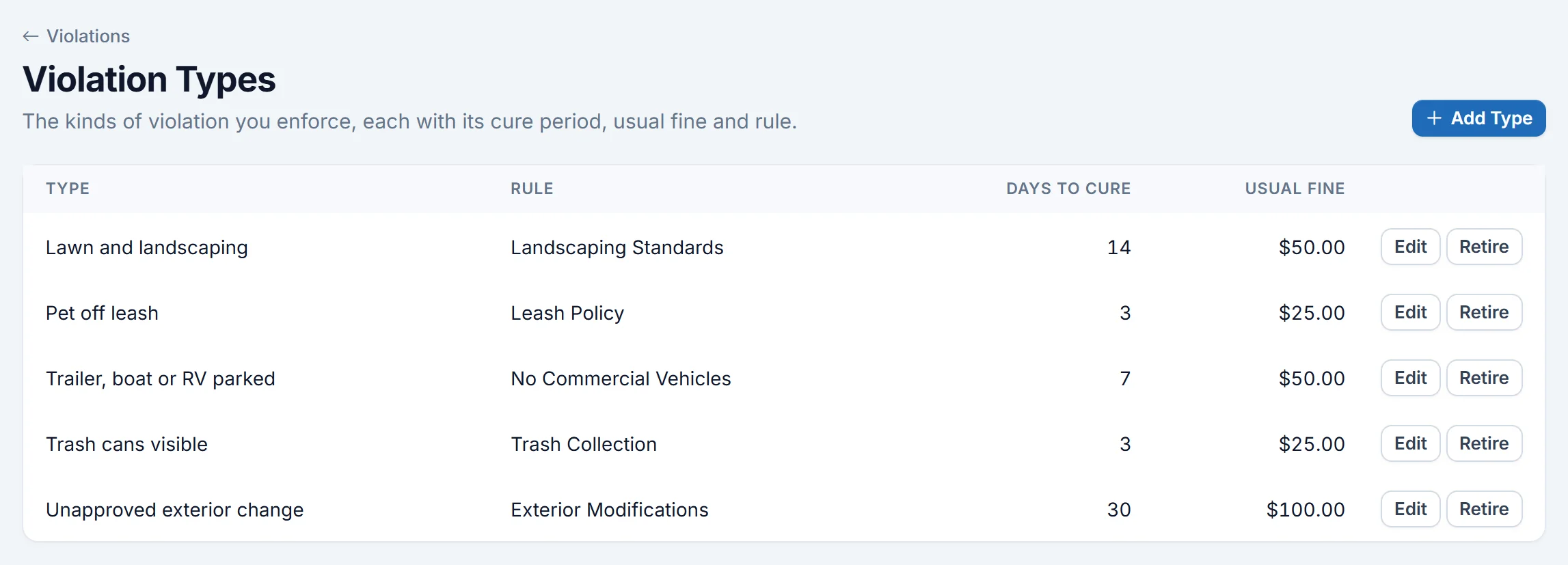
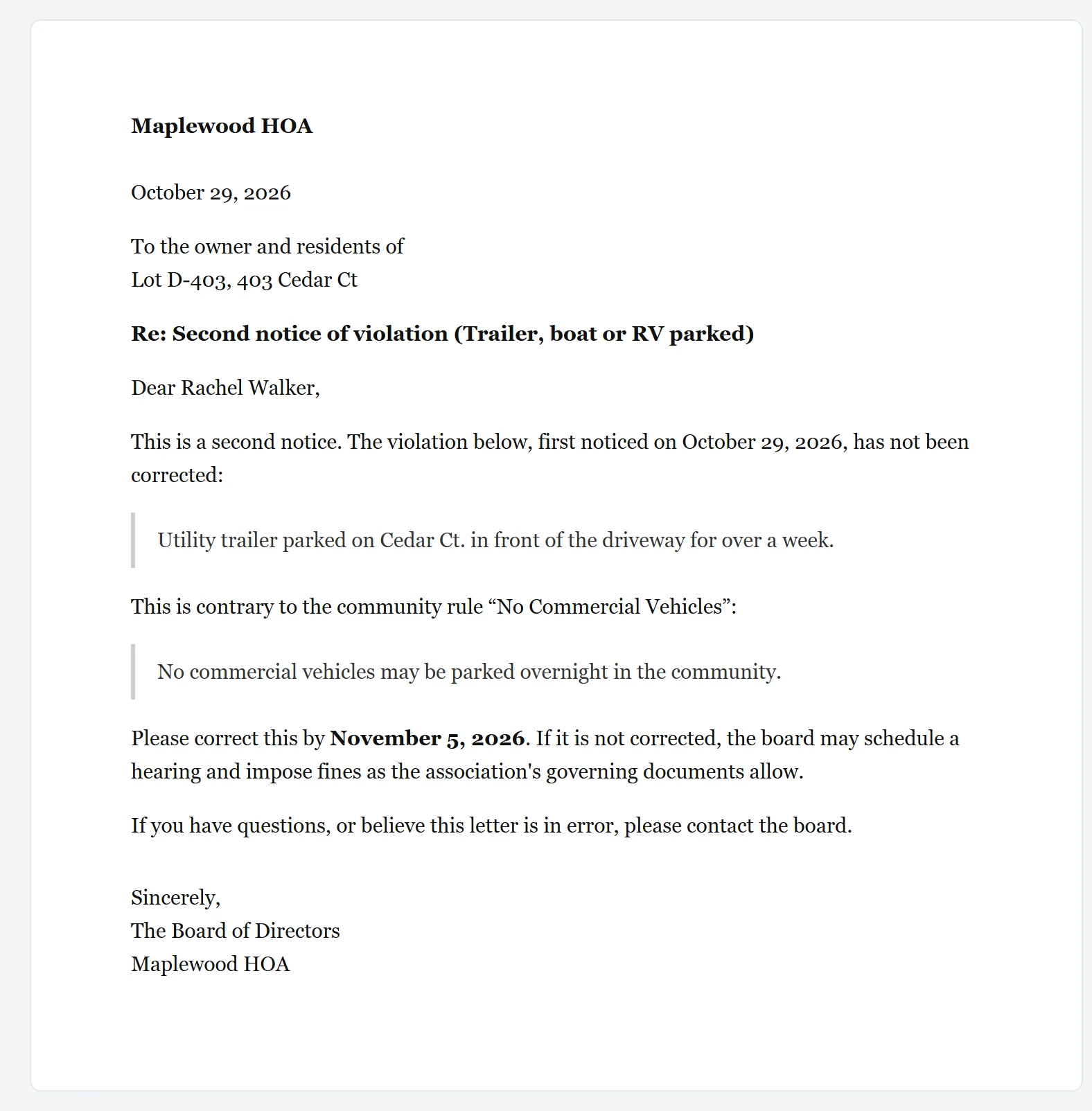
Real HOAOS screens with demo data; names and figures are made up.
Limits
What HOAOS doesn't do (yet)
Residents can't report violations
Only the board and managers log them; residents can contact the board.
Notices don't send on a timer
A board member sends each notice. Recurring fines are the one step that repeats automatically.
No separate appeal form
Owners are heard at the hearing, and can dispute a fine charge afterward.
Does HOAOS send violation letters automatically?+
No. In HOAOS a board member sends each notice, so nothing goes to an owner without a decision. Once sent, HOAOS emails the letter to the unit's current residents and stores the letter exactly as it went out.
Can HOAOS mail violation notices for us?+
Yes. From a violation's history, HOAOS can print and mail a notice first class or certified, with tracking. The price is shown before you send and appears on your next HOAOS invoice. You can also print letters yourself.
How do violation fines reach the owner's account in HOAOS?+
A fine in HOAOS posts as a charge on the unit's ledger, next to dues, and the fine notice goes to the owner. A weekly or monthly fine posts again each period until the board stops it or closes the violation.
Can we hold violation hearings at a board meeting in HOAOS?+
Yes. When you schedule a hearing in HOAOS you can pick an upcoming board meeting; the hearing joins that meeting's agenda and links back to the violation. You can also give a hearing its own date, time and place.
Can homeowners see their violations in HOAOS?+
Yes. Owners and tenants see the violations on their own units in the HOAOS resident portal, with photos, letters, history and board notes. They never see violations on other units.
Keep exploring HOAOS
Get started
Enforce the rules fairly.
The same steps for every owner, and a record of each one.